
AI & Career Guide
Top 10 AI Technologies to Learn in 2027 for Students and Freshers
Artificial Intelligence is changing how businesses develop software, analyse data, automate tasks and deliver digital services. Learn which technologies to explore, where to begin and how to build practical skills for your career.
Introduction
From Generative AI tools and intelligent chatbots to Machine Learning models and automated software testing, AI technologies are becoming an important part of modern IT. For students, freshers and working professionals, learning the right technology in 2027 can help build a strong foundation for future career opportunities.
You do not need to learn every technology at once. Starting with programming, understanding data and building practical projects can make learning more effective. If you are exploring Artificial Intelligence training in Coimbatore, an AI course for beginners or job-oriented IT courses with placement assistance, understanding these options can help you choose a learning path that suits your goals.
At Indra Institute of Education (IIE), Coimbatore, students can enquire about available IT training pathways, practical learning opportunities and placement assistance.
Why Should Students Learn AI Technologies in 2027?
AI is increasingly used in software development, customer service, business analytics, cybersecurity and digital operations. Learning AI-related skills can help students understand these developments and prepare for technology-focused roles.
- Automation: Understand how repetitive tasks can be automated using software and AI tools.
- Data-driven decisions: Learn how Data Analytics and Machine Learning can identify patterns and support business decisions.
- Software development: Explore AI-assisted coding alongside programming fundamentals and application development.
- Business applications: Understand how Generative AI can support content creation, research and customer interactions.
- Career development: Build practical skills through projects, technical training and interview preparation.
Top 10 AI Technologies to Learn in 2027
1. Generative AI and Large Language Models
Generative AI can generate text, summarise documents, assist with coding and help people work with information. Large Language Models (LLMs) power many conversational AI applications.
Start by learning effective prompting, checking AI-generated answers, understanding limitations and using AI tools responsibly. As you progress, explore APIs, retrieval-augmented generation (RAG) and applications that connect AI models with useful information.
Who should learn it? Students, freshers, developers and professionals interested in AI-powered applications.
Recommended starting point: Basic programming and an understanding of how AI systems process information.
2. Machine Learning
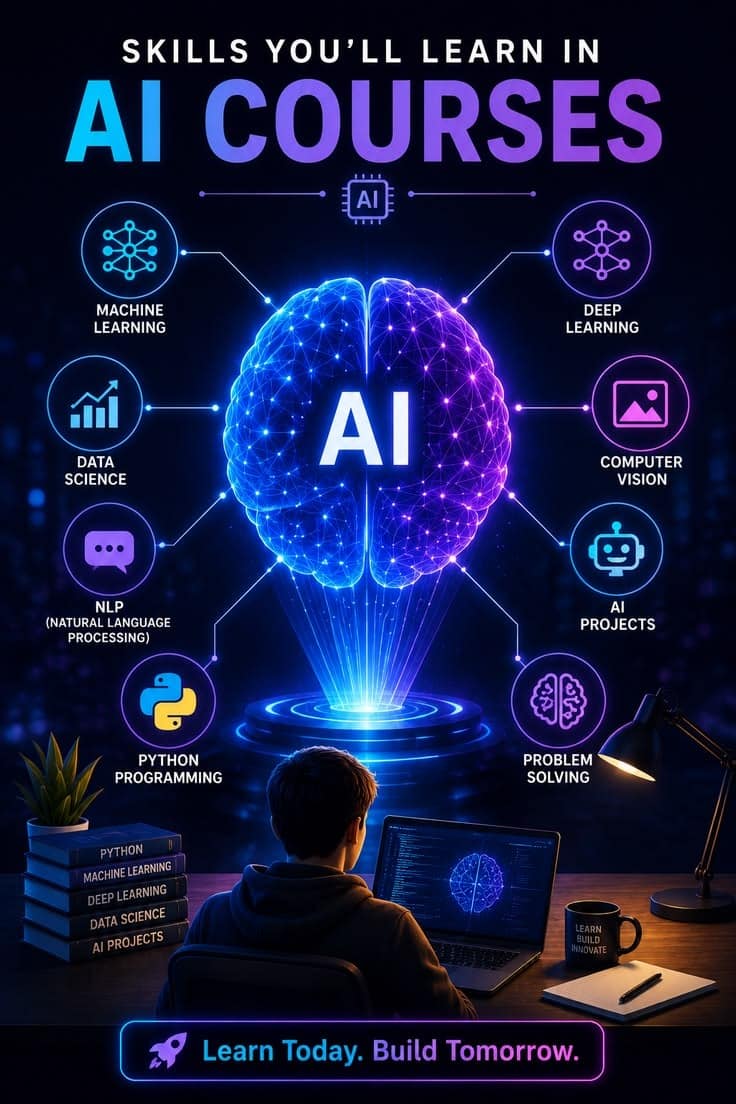
Machine Learning (ML) is a branch of AI that enables computer systems to learn patterns from data and make predictions or classifications. Common learning areas include supervised learning, unsupervised learning, model evaluation and data preparation.
Practise with small datasets, such as predicting sales trends or classifying customer feedback. Understanding model accuracy, limitations and data quality is just as important as learning algorithms.
Who should learn it? Students interested in programming, mathematics, experimentation and data-driven problem-solving.
Recommended starting point: Python, basic statistics and data handling.
3. Python Programming for AI
Python is useful for AI, Machine Learning, automation, backend development and Data Analytics. Its readable syntax and extensive libraries make it suitable for beginners who want to progress towards advanced technologies.
Begin with variables, conditions, loops, functions, data structures and debugging. Then explore libraries for data processing and Machine Learning before creating small applications. Python also provides a foundation for Full Stack Development and AI-assisted software projects.
Who should learn it? Beginners, college students, freshers and learners planning to enter software development or AI.
Recommended starting point: Python fundamentals followed by practical programming exercises.
4. Data Analytics and Business Intelligence
Data Analytics helps businesses convert raw data into meaningful insights. It involves collecting, cleaning, analysing and presenting information to support decisions.
Start with spreadsheets and SQL, then progress to Power BI and Tableau for dashboards and visual reporting. Python can be added later for more advanced data processing and automation. A useful beginner project is to analyse sales data, identify trends and create a dashboard that explains the findings clearly.
Who should learn it? Students who enjoy numbers, reports, business problems and visual presentations.
Recommended starting point: Excel, SQL, basic statistics, Power BI and Tableau.
5. AI Agents and Workflow Automation
AI agents are systems designed to work towards a goal by combining AI models with tools, instructions and, in some cases, multiple steps of decision-making.
An AI-powered workflow might organise information, search approved sources, summarise findings and prepare a draft report. More advanced systems may connect to databases or business applications with appropriate permissions. Learn to check outputs, control access and ensure automated actions are safe.
Who should learn it? Learners interested in automation, application development and practical AI solutions.
Recommended starting point: Python, APIs, Generative AI fundamentals and workflow design.
6. Full Stack Development with AI Integration
Full Stack Development involves creating web applications across the frontend, backend, databases, APIs and deployment process. Developers can integrate AI features such as chat interfaces, document summarisation and intelligent search.
A Python-based learning pathway may include Python, a web framework, JavaScript, SQL, version control and testing. Later, explore AI APIs and cloud deployment. For example, you could build a course enquiry application with a database, an admin dashboard and an AI-assisted FAQ feature.
Who should learn it? Students who enjoy building websites, applications and software products.
Recommended starting point: Python or JavaScript, HTML, CSS, databases and application development fundamentals.
7. AWS Cloud Computing and DevOps
Cloud computing provides access to computing resources and services over the internet. Amazon Web Services (AWS) is a major cloud platform used for hosting applications, managing data and deploying software.
DevOps combines development and IT operations practices to improve software delivery through collaboration, testing, automation, deployment and monitoring. Learn networking, Linux, scripting and version control before moving into cloud services and automation tools.
Who should learn it? Learners interested in cloud infrastructure, software deployment and IT operations.
Recommended starting point: Networking, Linux, Git, scripting and cloud fundamentals.
8. Cybersecurity and AI-Powered Security
Cybersecurity focuses on protecting applications, networks, devices and information from digital threats. AI can assist security teams by analysing patterns, identifying suspicious activity and prioritising alerts.
Build a foundation in networking, operating systems, access control, Linux and basic scripting. As you progress, explore security monitoring, vulnerability assessment and incident response. Ethical hacking practice must take place only in authorised environments with explicit permission.
Who should learn it? Students interested in networks, system protection and investigating security problems.
Recommended starting point: Networking, Linux, security fundamentals and authorised lab practice.
9. AI-Powered Software Testing and Selenium Automation
Software testing helps ensure applications work correctly, reliably and securely. Selenium is widely used to automate browser-based testing, while AI-assisted testing tools can help analyse failures, generate test ideas and organise testing workflows.
Learn software testing fundamentals, test cases, bug reporting and web application basics before progressing to automation. A beginner project could involve automating login, form submission and navigation tests on a permitted test website.
Who should learn it? Freshers interested in software quality, testing and automation.
Recommended starting point: Manual testing fundamentals, programming basics, web concepts and Selenium.
10. Power BI, Tableau and AI-Assisted Business Reporting
Power BI and Tableau help users transform data into interactive dashboards, charts and reports. AI-assisted features can make it easier to explore data and explain findings, although results still need to be checked for accuracy.
Learn data cleaning, spreadsheets, SQL, visualisation principles and how to interpret business metrics. Practise by building dashboards using sample sales, finance or customer-service data.
Who should learn it? Students interested in reporting, analytics, business intelligence and data visualisation.
Recommended starting point: Excel, SQL, Power BI or Tableau, and basic statistics.
Which AI Technology Should Students Learn First?
The best starting point depends on your interests, existing knowledge and career goals. Use this table as a general guide rather than a fixed sequence.
| Career interest | Suggested learning path |
|---|---|
| AI and Machine Learning | Python → Statistics → Data Preparation → Machine Learning → Generative AI |
| Software Development | Python or JavaScript → Full Stack Development → APIs → AI Integration |
| Data Analytics | Excel → SQL → Power BI/Tableau → Python |
| Cloud and DevOps | Linux → Networking → Git → AWS → DevOps |
| Cybersecurity | Networking → Linux → Security Fundamentals → Practical Labs |
| Software Testing | Testing Fundamentals → Programming → Selenium → Automation |
| AI-assisted Business Reporting | Excel → Data Visualisation → Power BI/Tableau → AI-Assisted Analysis |
Beginners should focus on understanding the fundamentals and completing projects instead of collecting certificates without practical experience.
How Can Students Build Job-Ready Skills in 2027?
Learning a technology is only the first step. Practise applying your knowledge to real-world problems and documenting what you build.
Step 1: Choose one learning pathway
Select a course based on your interests. Python can support software development and AI, while SQL and Power BI are useful foundations for Data Analytics.
Step 2: Build practical projects
Create a portfolio containing two or three projects that demonstrate your skills. Examples include an analytics dashboard, a web application, an automated testing project or a simple AI-powered application.
Step 3: Develop communication and interview skills
Practise explaining your project, the problems you solved and the decisions you made. Communication and problem-solving matter alongside technical knowledge.
Step 4: Explore internships and placement preparation
Look for opportunities to gain practical experience. Confirm the actual internship arrangements and support offered by any training provider before enrolling.
Step 5: Compare courses before enrolling
Review the syllabus, trainer support, fees, duration, project work and placement-assistance process. No course can guarantee a job for every learner.
Explore IT Training Options at Indra Institute of Education, Coimbatore
Indra Institute of Education (IIE) gives students an option to explore job-oriented IT learning pathways and enquire about placement assistance. Ask the institute to confirm current course availability, syllabus, fees, batch timings, practical projects and support options before making a decision.
Gandhipuram Branch
Students can enquire about available pathways related to:
- Cybersecurity and Ethical Hacking
- Selenium Testing and Software Testing
- Python and Full Stack Development
- Artificial Intelligence and Machine Learning
- AWS, Cloud Computing and DevOps
- Data Analytics
Hopes Branch – Avinashi Road
Students can enquire about current options related to Tally Prime with GST, Digital Marketing, Advanced Excel with Copilot, Full Stack Python and Data Analytics, Power BI and Tableau, and Artificial Intelligence.
Kuniyamuthur Branch – Palghat Main Road
Students can ask about Python Programming, Data Analytics and Data Science, AI and Machine Learning, Power BI and Tableau, IT internships for freshers, and job-oriented software training.
Frequently Asked Questions (FAQs)
1. What are the top AI technologies to learn in 2027?
Important areas to explore include Generative AI, Machine Learning, Python, AI agents, Data Analytics, AI-integrated Full Stack Development, AWS/DevOps, Cybersecurity, automated software testing and AI-assisted business reporting. Choose based on your interests and build practical projects as you learn.
2. Which AI course is suitable for beginners in Coimbatore?
Beginners can start with Python fundamentals, basic data handling and an introduction to AI concepts. Compare prerequisites, syllabus, practical assignments, fees and available learning support before enrolling.
3. Is Python necessary for learning Artificial Intelligence?
Python is not the only way to work with AI, but it is a useful starting point because it is widely used in Machine Learning, data processing and AI application development. Beginners should learn programming fundamentals before moving to advanced projects.
4. Can freshers learn AI and Data Analytics without advanced coding knowledge?
Yes. Beginners can start with basic programming, spreadsheets, SQL and data visualisation, then gradually progress to more advanced topics. The learning path depends on the chosen course and the student's background.
5. Where can students enquire about job-oriented IT courses with placement assistance in Coimbatore?
Students can contact Indra Institute of Education to enquire about current IT courses, practical training and placement assistance. Ask about the Gandhipuram, Hopes and Kuniyamuthur branches and confirm current course details directly with the institute.
Conclusion
AI will continue to influence how people build software, analyse information and automate business processes. For students and freshers, a strong foundation in Python, data handling, software development and problem-solving can provide a useful starting point for exploring advanced technologies.
Whether you are interested in Generative AI, Machine Learning, Data Analytics, AWS/DevOps, Cybersecurity or software testing, focus on practical learning and projects that demonstrate your skills. Choose a pathway that fits your interests, compare course details carefully and keep building your knowledge step by step.